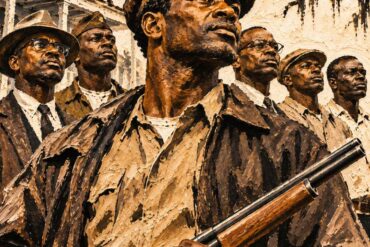
Before hockey had its celebrated legends, Black men were already rewriting the rules of the game.
The Colored Hockey League of the Maritimes was established in 1895, twenty-two years before the National Hockey League existed. Yet here I am, decades into my existence, just discovering a remarkable chapter of sporting history that should have been part of my education.
How in the hell did we miss this?
When we think of hockey, names like Wayne Gretzky, Sidney Crosby and Bobby Orr immediately come to mind. However, long before these men became household names, Black Canadian athletes were developing techniques that would become fundamental to modern hockey.
These gentlemen weren’t merely participating in the sport. They were experimenting, innovating and building an institution of their own.
The Colored Hockey League of the Maritimes: An Institution Born of Necessity
In 1895, the Halifax Eurekas faced the Dartmouth Jubilees in the league’s inaugural season. Black church leaders and intellectuals in Halifax and Dartmouth established hockey teams to encourage church attendance, strengthen community relationships and provide recreational opportunities for Black men excluded from other sporting institutions.
Among the prominent figures associated with the league’s development were Henry Sylvester Williams, James A. R. Kinney and James Robinson Johnston.
What began as a community initiative developed into a competitive sporting institution. Teams associated with the league included the Halifax Eurekas, Dartmouth Jubilees, Halifax Stanleys, Africville Sea-Sides and Amherst Royals.
These men didn’t wait for someone to extend an invitation. They organized their own competition, attracted spectators and created their own sporting culture.
There is something particularly magnificent about creating what others refuse to give you.
The Black Hockey Players Who Changed the Game
Now, here’s where this story becomes particularly interesting. Two techniques associated with modern hockey have early precedents in the Colored Hockey League of the Maritimes.
Eddie Martin and the Slapshot
Historical accounts credit Eddie Martin of the Halifax Eurekas with using an early form of the slapshot around 1906. Decades before the technique became synonymous with NHL great Bernie “Boom Boom” Geoffrion, Martin was already experimenting with this powerful method of striking the puck.
Imagine making a contribution to a sport so significant that generations of athletes would eventually depend upon it, yet your name rarely enters the conversation.
Henry “Braces” Franklyn and Modern Goaltending
Around 1900, Dartmouth Jubilees goaltender Henry Franklyn began dropping to his knees to prevent the puck from entering the net. At the time, other hockey competitions restricted such movements. His technique is recognized as an early predecessor of modern butterfly goaltending.
Although surviving records make absolute claims of invention difficult to establish, these accounts demonstrate that Black hockey players were experimenting with techniques well ahead of their widespread adoption.
They weren’t simply playing the game. They were questioning how the game could be played.
When Black Excellence Threatened the Established Order
The Colored Hockey League attracted both Black and white spectators. Its speed, physicality and unconventional approach made the competition especially entertaining.
However, access to indoor ice remained a significant obstacle. Conflicts involving railway development through Africville, Black community leaders, landowners and Halifax officials contributed to the league losing valuable rink access in the early twentieth century.
Furthermore, economic difficulties, World War I and the devastating Halifax Explosion of 1917 affected the communities that supported the league. Although the competition experienced a revival during the 1920s, some remaining clubs continued into the 1930s.
Consider the implications. An institution can possess extraordinary talent, attract customers and demonstrate commercial potential. Nevertheless, when somebody else controls access to its infrastructure, its survival becomes vulnerable.
That lesson extends considerably beyond hockey.
Black Ice: Recovering a Nearly Forgotten History
Much of the renewed attention surrounding the league comes from historians George and Darril Fosty and their book, Black Ice: The Lost History of the Colored Hockey League of the Maritimes.
Their research helped bring historical photographs, newspaper accounts and the accomplishments of these athletes back into public discussion.
In 2020, Canada Post issued a commemorative stamp featuring an illustration based on a 1904 photograph of the Halifax Eurekas. Additionally, in 2024, the Canadian government formally recognized the league as an event of national historic significance.
Recognition arrived more than a century after those gentlemen first took to the ice. Better late than never? Perhaps. However, I remain considerably more interested in understanding why recognition took so damn long.
Black Excellence Is Not a Footnote
What fascinates me about Black history is not simply the adversity our ancestors endured. It is what they managed to conceptualize, construct and accomplish despite it.
They established businesses, communities, hospitals, educational institutions and sporting organizations. They were intellectuals, entrepreneurs, architects and innovators.
As an artist, writer and lover of history, I find myself increasingly drawn to the intersection of historical discovery and creative expression.
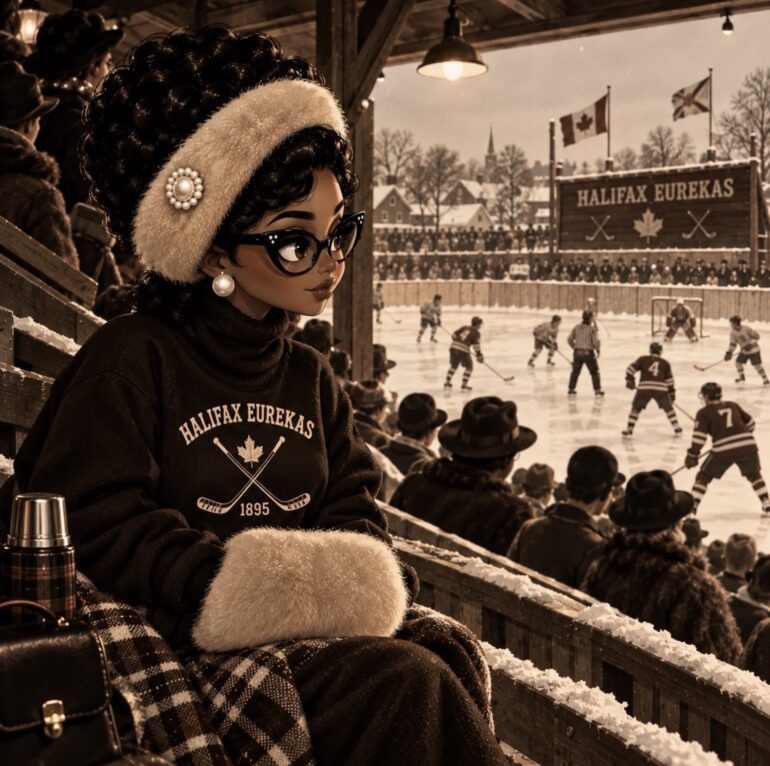
Consequently, I created a contemporary commemorative hockey jersey honoring the Halifax Eurekas and their legacy. It is my artistic interpretation of their contribution to sporting history, not a reproduction of an original team uniform.
For me, this piece is about carrying their story beyond the pages of a history book.
Closing Thought: Excellence Without Permission
I have always believed that originality is one of the most powerful expressions of intellectual independence.
The men of the Colored Hockey League of the Maritimes demonstrated precisely that. They built an institution within a society that restricted their participation. They experimented with established conventions and produced something worthy of recognition.
Their accomplishments do not require embellishment. The documented history is extraordinary enough.
Black history is not exclusively a history of suffering. It is also a history of imagination, enterprise, ingenuity and extraordinary intellectual capacity.
We must become as familiar with what our ancestors created as we are with what they endured.
Because Black excellence was never waiting to be discovered.
It was waiting to be acknowledged.
DAMN Y’ALL TO HELL OFFER NOT TEACHING ME THIS
~~ Kimberly
Frequently Asked Questions
When was the Colored Hockey League of the Maritimes founded?
In 1895, in Halifax and Dartmouth, Nova Scotia, Canada.
Who pioneered the slapshot in hockey?
Eddie Martin of the Halifax Eurekas is credited with using an early version of the slapshot around 1906.
Who pioneered butterfly goaltending?
Henry “Braces” Franklyn of the Dartmouth Jubilees pioneered an early form of kneeling goaltending around 1900.
Did the Colored Hockey League exist before the NHL?
Yes. The league was founded in 1895, while the NHL was established in 1917.
Further Reading and Historical Resources
- Parks Canada: Colored Hockey League of the Maritimes
- Maritime Sport Hall of Fame
- Hockey Nova Scotia: A Living Legacy
- Black Ice Hockey & Sports Hall of Fame Society
- Black Ice, George and Darril Fosty.
- Soul on Ice: Past, Present & Future (2015), documentary directed by Damon Kwame Mason.